

- Case Study
Flexicon crimp capping machine and Watson-Marlow cased pumps deliver seal quality, reliability and accuracy for Torbay Pharma
How solutions from Watson-Marlow supports Torbay Pharma’s production with consistent seals and accurate filling
How solutions from Watson-Marlow supports Torbay Pharma’s production with consistent seals and accurate filling
For consistent seal quality, reliability and accuracy in its fill-finish process, Torbay Pharma relies on a semi-automated crimp capping machine alongside peristaltic pumps from Watson-Marlow Fluid Technology Solutions (WMFTS).
Torbay Pharma, based in Paignton in England, is a contract manufacturer and license holder of sterile injectable solutions for the healthcare sector. It helps pharmaceutical companies bring their essential medicines to market efficiently and reliably while meeting demand from hospitals.
At its MHRA GMP-approved facility, Torbay Pharma provides an uninterrupted supply of fill-finish services for terminally sterilized injectables in plastic and glass vials and ampoules, following robust cGMP requirements.
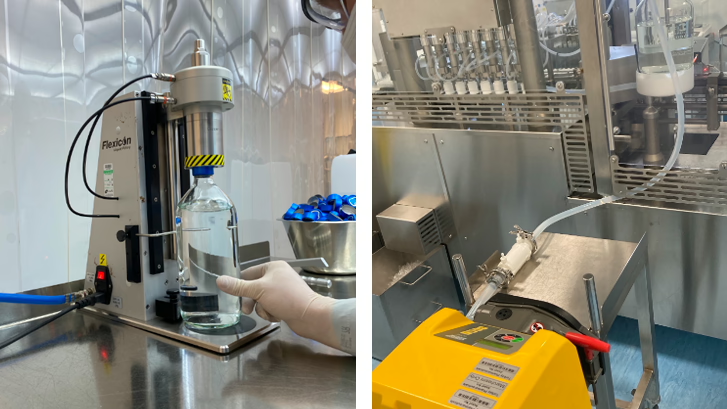
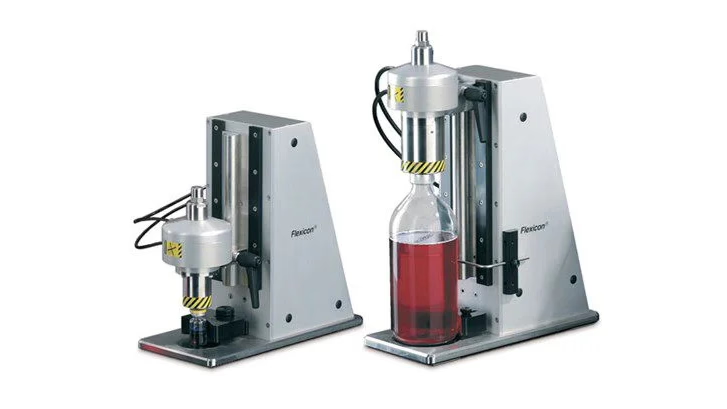
Torbay Pharma uses the Flexicon FS32 crimp capping machine to cap large volume parenteral nutrition (PN) products in 500 mL (1500 units) and 1 L bottles (approximately 600 units), and processes three to four batches per week. The FS32 is used for approximately 10 TPN (Total Parenteral Nutrition) products, ensuring continuous supply to NHS sites, local hospitals and compounding units (specialist medicine‑mixing rooms).
Positioned at the end of a manual hand-filling line, the semi-automated FS32 applies the final crimp once solutions have been filled, stoppered and capped. Operators place the bottles into the capping machine, where the final seal is applied to secure the closure.
“The maintenance is straightforward and we are happy with how reliable it is because we have had the same crimp capping machine for over a decade.”
Nik Garrett, Production Manager at Torbay Pharma, said: “Crimping is a really important aspect for us due to container integrity. It ensures the stopper remains in place and that there is no route of entry into the bottle for any potential contamination. A portion of those bottles are put through a container integrity vacuum test after crimping to show that we have a sufficient seal and full container integrity of our product.
“If the capper wasn't consistently crimping, there would be a direct impact to the product. That could be introduction of microbial contamination, loss of sterility or precipitation of the product if it was open to the environment, which then could cause the assay to go out of specification and the drug product not do as it is intended. It's really important for us that that crimp provides that assurance and the stopper is going to remain in place.”
The FS32 tabletop capping machine is designed for fast, simple operation while protecting users from repetitive strain injury (RSI). An operator can crimp more than 1,000 units per hour and as the machine is simple to use, it minimizes risk of production problems caused by inexperienced operators.
Torbay Pharma has used the Flexicon units for over a decade, with one in use, one in maintenance, and one in storage as a spare.
“The maintenance is straightforward and we are happy with how reliable it is because we have had the same crimp capping machine for over a decade,” Garrett said.

“Flexicon systems are also really easy to use. We go from 500 mL to 1 L bottles, so they differ in height. We've also got variances in the specification of the bottles that actually come to us, so you could find that a batch requires a bottle specification at the top of its specification and you need to make that minor manual adjustment to give the required crimp. They come with set-up guides and the discs for easy set-up, which is really useful. When we're making the batches, it's relatively straightforward to set up and doesn't take it doesn't take a lot of time.”
Sheetal Inamdar, sales engineer at WMFTS, said: “Key qualities of using our capping machines for Torbay Pharma is the consistency they are able to deliver and the ease of use. They have also commented on the longevity of the product as they have had these units on site for some years now and they continue to perform well.
“Torbay Pharma have only recently asked for our support on servicing the FS32 cappers, and therefore there have been minimal maintenance costs for these over the years of service.
“Due to a gap in maintenance knowledge on site with the existing operators after a previous expert had moved on, rather than providing an annual service alone, we offered a visit from one of our engineers to provide training for the operators to allow them to be self-sufficient for regular maintenance and switching between vial sizes. The customer was extremely appreciative of the knowledge and support that our trainer was able to share.”
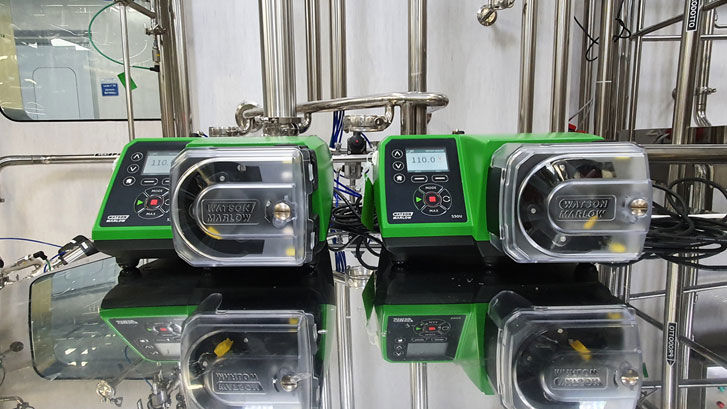
Torbay Pharma also uses four Watson-Marlow 630 series peristaltic pumps to transfer aqueous solutions from bulk formulation vessels (600 L) in a formulation room, to the filling line and a header tank. These pumps are used daily on each of Torbay Pharma’s filling lines to ensure a continual flow of solution for the dosing stage.
The pumps are integrated as part of the filling machine and are linked with a fitted communications lead. The pump is run on automatic mode so that when the header tank on the filler reaches the low-level sensor, the pump activates to transfer solution to the filler, then stops once the tank is full.
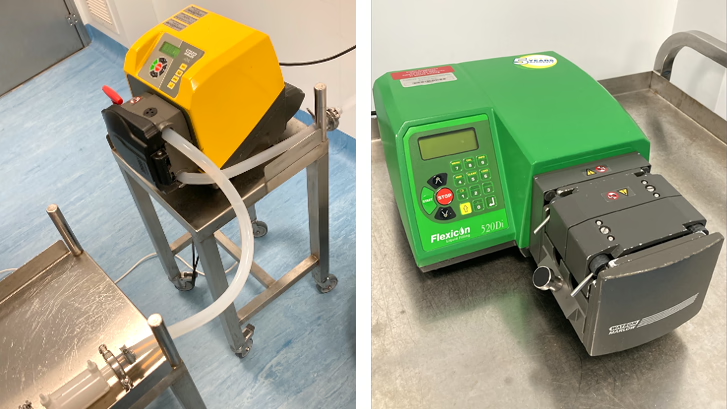
The pump is then working alongside the filling machine to ensure the header tank is always full ready for precise dosing. Maintaining this automatic transfer throughout production is essential, particularly given the distance between the formulation vessels and the filler. It ensures a continuous, reliable flow of solution over the entire production run.
Torbay Pharma also uses Flexicon 520Di dispensing pumps, from WMFTS, on its hand filling products from 10 mL to 150 mL volumes.
As well as the accuracy, the pumps’ compact footprint and portability are essential. Operators move the pumps around the facility on purpose-built trolleys depending on where they are needed.
“We're bound by licenses for tolerances and fill volumes so being able to fill accurately and repeatedly is crucial,” Garrett said.
“Many of our products are doses that go directly to the patient and we've got specific tolerances that we need to be within. If we underfill, the patient wouldn't receive the correct amount. If we overfill, there's a potential overdose. The Flexicon 520Di dispensing pump allows us to meet those tolerances.
“We can set the dosing speed, slow it down for newly trained operators, and then speed it up to improve throughput. They’re easy to set up, and because they use single-use tubing and there are no pistons with no pump parts that need cleaning, there’s minimal risk of cross-contamination. That's really important to us with the range of products that we make.”
Biotech
Aseptic liquid filling for biotech and pharmaceutical industry
Biotech
Pumps for use in the biotech and pharmaceutical sector
Case Study
Since adopting Flexicon systems, productivity has increased and risk of batch variations has been...
Case Study
Case Study
Flexicon’s integrated solution for Müggenburg Pharma's filling line increases capacity for...
Case Study
To learn more about our solutions for your applications please