
- Insight
Why hose selection matters in breweries
FaBLINE reduces contamination risk, protects shelf life and maximises uptime
FaBLINE reduces contamination risk, protects shelf life and maximises uptime

by Matthew Coultas, Business Development Manager, Aflex Hose
Contamination, dissolved oxygen pickup, loss of carbonation and unplanned maintenance downtime are some of the costliest challenges faced by breweries today, which can lead to wasted product, reduced shelf life and expensive operational disruption. But these stressful scenarios can be avoided by a strategic, often overlooked decision of selecting the right hose for each brewery application. With the correct hose technology in place, brewers can safeguard consistent product quality and optimise cleaning processes.
Hoses are used in breweries for unloading raw materials and various transfer tasks in production, through to conveying product in filtration, packaging and high speed bottling and canning lines. But hose assemblies must do more than simply transfer product.
Over the last 20 years, clean-in-place (CIP) and sterilise-in-place (SIP) processes have evolved to be more frequent, use more aggressive chemicals, and operate at higher temperatures than ever before. Therefore, hoses in breweries must withstand repeated cleaning cycles through chemical and temperature resistance, as well as maintain hygiene and deliver long, reliable service life without compromising beer quality.
Ideal qualities for hoses in brewery applications include:
In brewery operations, hoses are exposed to product transfer, repeated filling and cleaning cycles which use aggressive chemicals. Wetted surfaces are routinely subjected to prolonged CIP processes that remove soils and kill bacteria. These cleaning cycles often last over an hour daily, or after every product changeover, placing significant stress on hoses. It is often the cleaning process that has the most significant impact on hose life and total cost of ownership. The duration of a CIP cycle can also have a significant impact on productivity of a brewery.
The chemicals used in such cleaning operations depend primarily on the nature of the soils (unwanted matter on the surface of food or beverage contact surfaces). These are composed primarily from product residues but may also include: minerals from the water supply; insoluble detergent residues; sticky biofilms formed by micro-organisms, and environmental contaminants such as dust or machine lubricants. These soils provide a nutrient source for bacteria and must be removed.
In brewery environments, yeasts and bacteria can form invisible films on surfaces that are very difficult to remove. As a result, highly oxidising, acidic cleaners and sanitisers are required, such as phosphoric, nitric or hydrochloric acids.
Once soils have been removed, sanitisation is required to destroy residual micro-organisms. Depending on the beverage and process, this may involve steam, hot water, or chemical sanitisers.
Chlorine is the most widely used form of chemical sanitiser and may be applied as liquid chlorine, sodium hypochlorite, or inorganic chloramines. In solution, these form hypochlorous acid (HOCl), whose effectiveness depends on pH, concentration, temperature and exposure time.
Other sanitisers include peroxides, fatty acids, quaternary ammonium compounds, and iodine. Collectively, these impose an extremely aggressive operating environment for hose materials.
Evaluating hoses exposed to standard CIP cleaning and sterilising chemicals, residual areas of biofilm after CIP
| Hose type / pressure rating | Expected lifetime | Performance characteristics |
| FaBLINE PTFE-lined / 16 bar | 5 years | Long life; resistant to CIP/SIP processes |
| Nitrile rubber / 10 bar | 9-12 months | Low cost; rapid degradation under CIP conditions |
| EPDM rubber / 10 bar | 12 months | Better chemical resistance than nitrile; limited-service life |
| Silicone rubber / 6 bar | 18 months | Embrittlement and extractables after CIP |
| FEP-lined rubber / 30 bar | 2 years | Risk of adhesive leaching and liner fatigue |
Nitrile rubber hoses are widely used due to their low purchase cost, but they begin to deteriorate when exposed to standard CIP cleaning and sterilising chemicals. EPDM rubber hoses are more expensive than nitrile with better general chemical and temperature resistance. EPDM offers improved resistance but still suffers from limited service life.
Silicone hoses provide flexibility and high temperature capability and are common in beverage filling applications. However, silicone can embrittle and release degradation products after exposure to CIP chemicals, compromising product quality.
FEP lined rubber hoses offer improved chemical resistance, but adhesive bonded liners introduce risks of leaching, collapse and fatigue cracking, particularly in high flex or tight bend applications.
FaBLINE™ hoses from Aflex Hose, a Watson-Marlow Fluid Technology Solutions (WMFTS) company, are resistant to all CIP and SIP processes whether it is chemical, temperature or duration of cleaning. FaBLINE’s advanced construction allows breweries to:

“FaBLINE’s smoothbore PTFE liner improves soil removal and reduces cross contamination risk by eliminating product entrapment, microbial hotspots and residue build‑up after transfer”
FaBLINE’s smoothbore PTFE liner improves soil removal and reduces cross contamination risk by eliminating product entrapment, microbial hotspots and residue build‑up after transfers.
As filling and packaging line speeds continue to increase, unplanned downtime has become more costly. Total cost of ownership must therefore consider far more than initial hose cost such as:
Hose performance also impacts more than just the brewery. When a hose fails, it is often perceived as a machine failure, directly affecting the reputation of the filling machine manufacturer. This makes hose selection important for breweries and filling machine manufacturers.
PTFE-lined hoses like FaBLINE outperform PVC, nitrile, EPDM, chloroprene, IIR, silicone and HDPE hoses for the requirements of beverage packaging machines.
FaBLINE’s construction is ideal for the repetitive up-and-down action of a can-filling machine. Laboratory tests by Aflex (using a rolling U-test machine) have shown that FaBLINE can withstand over 100,000 cycles of repeated flexing at tight bend radii and maximum working pressure. In comparison, some competitor hoses failed at fewer than 13,400 cycles.
Performance of various common hose construction categories relative to the ideal hose characteristics
|
Required Attribute |
Convoluted (Wired) |
Convoluted (Unwired) |
Rib & Web (Smooth Internally) |
Smooth Liner (Thickwall) |
Smooth Liner (Thinwall) |
|
Non-leaching |
Good |
Good |
Good |
Good |
Poor |
|
Cleanability (internal) |
Fair – Poor |
Fair – Poor |
Good |
Good |
Good – Poor |
|
High flow capacity |
Poor |
Poor |
Good |
Good |
Fair |
|
Kink proof |
Good |
Fair |
Good |
Poor |
Poor |
|
Flexibility (small bend radius) |
Good |
Fair |
Good |
Poor (polymers) / Good (elastomers) |
Fair |
|
Flexibility (low force to bend) |
Good |
Good |
Good |
Poor (polymers) / Good (elastomers) |
Fair |
|
High flex life |
Good |
Good |
Good |
Poor |
Poor |
|
Application suitability |
Sub-optimal flow; CIP issues for deep convolutions |
Sub-optimal flow; risk of kinking; CIP issues |
Suitable for high-speed filling |
Stiff; large minimum bend radius; prone to kinking; limited life |
Less stiff; risk of liner delamination and adhesive leaching |
Mitigating the risk of oxygen pickup is also especially critical during the packaging process that transfers the beer to cans, bottles, or kegs. Some hoses can contribute to elevated levels of dissolved oxygen (DO), which affect the taste of the final product and reduce shelf life of the beer.
For every 10 ppb (parts per billion) of DO there is one less month of shelf life, and the flavour of the beer is compromised.
Cervecería La Tropical, one of Miami’s most iconic breweries with deep historic Cuban roots, increased efficiency on its canning line by installing FaBLINE and resolving issues with DO.
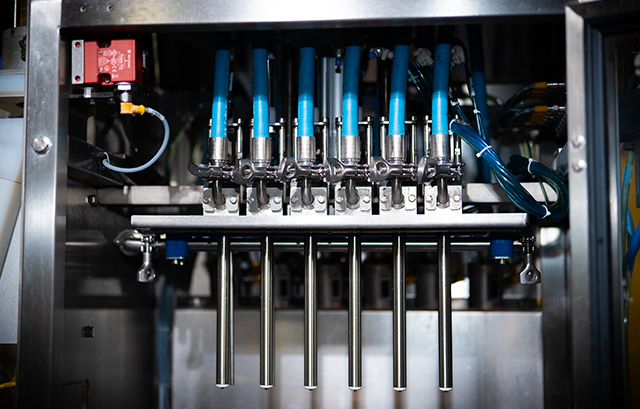
After experiencing oxygenation in its canning line caused by PVC hoses, La Tropical switched to FaBLINE (0.5") with blue EPDM cover and Tri-clover connections in 2023.
Twelve FaBLINE hoses on La Tropical’s canning line have reduced dissolved oxygen levels by 50 ppb to almost nothing. La Tropical is also using a FaBLINE hose to transfer already carbonated beer from the bright beer tank to the flash pasteuriser after experiencing loss of carbonation with EPDM hoses due to foam in the same application.
Also in the United States, Pennsylvania-based Wyndridge Farm craft brewery and cidery turned to FaBLINE to urgently resolve unacceptably high levels of DO prior to packaging an order for 21,000 cases of craft beer from a European wholesaler.
Wyndridge Farm diagnosed the problem by taking DO measurements along its production line and discovered the silicone hoses in the can-filling machine as the location of oxygen pickup.
Within a day, Wyndridge were able to reduce its DO levels from 100-150 ppb to well under 50, and ship its European order on time.
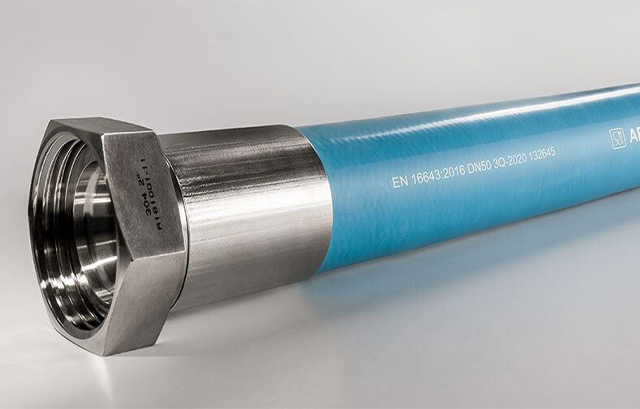
“FaBLINE’s design allows the PTFE liner to expand around the outside and compress on the inside of bends. This maintains a smooth circular bore throughout the hose, without distortion, resulting in smooth, consistent flow with minimal turbulence to reduce the risk of micro‑aeration during transfer“
FaBLINE’s design allows the PTFE liner to expand around the outside and compress on the inside of bends. This maintains a smooth circular bore throughout the hose, without distortion, resulting in smooth, consistent flow with minimal turbulence to reduce the risk of micro‑aeration during transfer.
The PTFE liner also reduces oxygen ingress through the hose wall and its strong CIP/SIP resistance prevents cracks or permeable layers that help oxygen from forming. Also, the external braid prevents hose expansion/contraction that can draw in oxygen, which is important during the transfer and filling stages.
FaBLINE’s features have been proven to help protect beer from oxidation, preserving flavour and shelf life.
A major brewery based in Mexico switched to FaBLINE to enhance reliability, hygiene and supply continuity at its breweries in Mexico, while showing no negative effects to robust CIP regimes.
The brewery, which produces world-renowned beers, had been using NBR (nitrile butadiene rubber) hoses since its commissioning. Over time, technical support and replacement availability from both the manufacturer and local distributors became unavailable. Hose performance, cleanliness and durability are important requirements of the hose for the unloading tomato juice, which is a high-quality ingredient used in a michelada-style beer. After unloading the tomato juice, FaBLINE hoses are cleaned using a CIP process with hot water and caustic soda.
Following a detailed technical assessment carried out jointly by Watson-Marlow’s engineering team and the brewery’s maintenance department, the Aflex FaBLINE 3” with food grade fittings was selected. Initially, one hose was supplied for trial, followed by additional hoses a year later. Since implementation, the brewery has reported stable operation with no hose failures over two years for one hose, and one year for two hoses.
FaBLINE delivers flexibility and fatigue resistance in a smoothbore, high flow hose. FaBLINE’s non-bonded construction will not leach anything into the product and it has at least ten times the fatigue life of the FEP smoothbore hose in rolling-U tests. FaBLINE has a small bend radius, minimum force to bend, and is easy to fit.
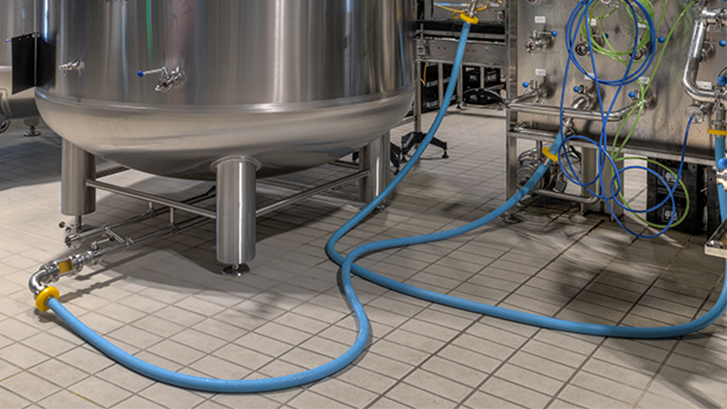
When switching to FaBLINE, Switzerland-based craft brewery Dr. Gab’s gained a significant increase in operating time, reliability and process safety, compared to the rubber hoses previously used in the brewery. With the previously used rubber hoses, Dr. Gab’s experienced defective and burst hoses which resulted in excessive cleaning and loss of product.
Consequently, Dr. Gab’s has increasingly relied on FaBLINE hoses for transferring the beer to and from the carbonator. Since purchasing over 25 FaBLINE hoses, Dr. Gab’s primarily uses them for challenging applications, such as final carbonation. After carbonic acid is added, the beer is transferred to the bottling line under high pressure.
Flexible, non-kink FaBLINE hoses are being used for a variety of applications at breweries around the world for their reliable, hygienic performance and longer lifetime compared to other hoses.
For breweries changing hoses every one, two or even three years, it is time to turn to a more cost‑effective, hygienic solution. When the full cost of downtime, product loss and cleaning efficiency is considered, FaBLINE provides rapid payback and long‑term operational confidence.
FaBLINE hoses offer these benefits for brewery companies:
To order a product or ask a question call +27 11 796 2960 or