
- Case Study
Corroline+ hoses eliminate blockages and improve process reliability for Cornish Lithium
Corroline+ transfers a mica slurry treated with sulphuric acid at hard-rock lithium mining demonstration plant
Corroline+ transfers a mica slurry treated with sulphuric acid at hard-rock lithium mining demonstration plant
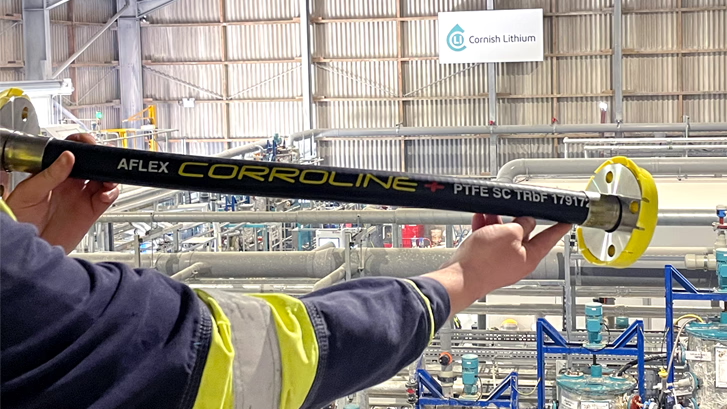
After experiencing blockages caused by rigid pipework with 90-degree bends, Cornish Lithium switched to flexible Corroline+ hoses for transferring a mica slurry treated with sulphuric acid at its hard-rock lithium mining demonstration plant near St Austell in Cornwall, England.
At the Trelavour Lithium Project, the first stage of processing to produce lithium hydroxide monohydrate involves crushing, milling and refining granite ore from a former china clay (kaolin) pit to produce a lithium‑rich mica (zinnwaldite) concentrate slurry. This is followed by hydrometallurgical processing, where the mica concentrate undergoes acid leaching using sulphuric acid.
Corroline+ hoses play a critical role in this stage, transferring acid slurries to drive the leaching reaction, as well as supporting downstream processes including impurity removal and by‑product recovery.
After experiencing problems with the flow of mica concentrate slurry due to bends in the plastic piping, Cornish Lithium needed a flexible hose solution that was tough enough to withstand the harshest operating conditions at Trelavour.
Since late 2024, Cornish Lithium has installed 15 Corroline+ hoses, from Aflex Hose, a Watson-Marlow company, to replace sections of rigid pipework across the hydrometallurgy stage. The hose’s smooth bore ensures uninterrupted flow of mica concentrate slurry in a cascade between process tanks. Their flexibility enables a more direct flow path, eliminating problematic bends and reducing the risk of sedimentation and blockage.
The Corroline+ hoses contribute to Cornish Lithium’s strategy of developing a sustainable mining process that is as efficient as possible.
Dai Moseley, senior process manager for hard rock minerals at Cornish Lithium, said: “We chose this process because its lower energy consumption and it makes preferable by-products. The hoses are allowing us to do this process as efficiently as possible.
“It’s a slow-moving process, moving from one tank to another in a cascade so there’s barely enough velocity to keep the slurry solids in suspension. We want the same fall between tanks rather than the slurry settling at a 90-degree bend and causing us to clear the blockage. The hoses give us a more direct route than the rigid pipework, so it works better for us. When there’s a block, the Corroline+ hoses are easy to take apart and clean out.
“It’s a highly concentrated sulphuric acid at temperatures above 90°C to leach out all the metals from the mica and turn them into metal sulphates. It’s hot, acidic and abrasive so the conditions couldn’t be harsher for the hoses but we haven’t had an Aflex hose fail on us. They are the worst conditions in the plant, but the hoses handle it.”
“It’s hot, acidic and abrasive so the conditions couldn’t be harsher for the hoses but we haven’t had an Aflex hose fail on us. They are the worst conditions in the plant, but the hoses handle it.”
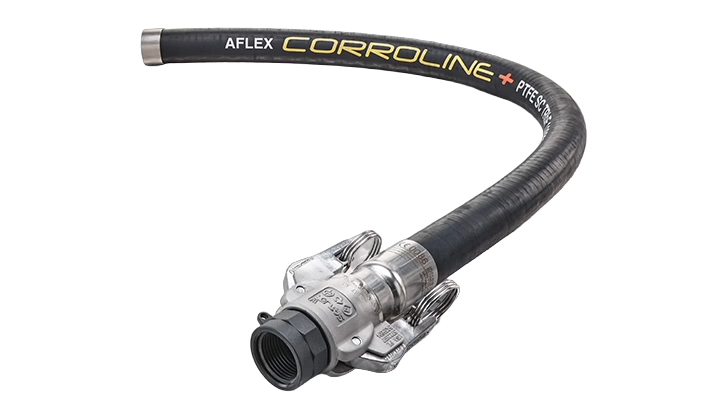
Lined with polytetrafluorethylene (PTFE), Corroline+ provides excellent chemical and temperature resistance with an internally smooth bore to ensure fast flow. Corroline’s flexibility also met Cornish Lithium’s process requirements.
The PTFE-lined flanges or Hastelloy BSPT threads of Corroline+ provide superior chemical resistance and reliability compared to convoluted metal hoses. A stainless helical wire is wound into the external convolutions, which adds to the kink resistance. A secondary helical wire embedded into the black, fire resistant, antistatic EPDM rubber cover, further adds to the kink resistance.
These qualities of Corroline+ have helped Cornish Lithium simplify maintenance and improve reliable long‑term performance at its chemical separation stage.
Chris Clasby, engineering manager at Cornish Lithium, said: “The hoses are durable and a solution to sharp bends in our pipework. The pipework was rigid with 90-degree bends which do not work with our slurry. We have been able to delete the bends with the hoses which are easy to dismantle, inspect and bend. We haven’t had any issues with kinks either.
“From a replacement perspective, the piping has been difficult and we are now in the process of changing to easier to use Corroline+ hoses.
“The Corroline+ hoses have been reliable. An unreliable hose would mean downtime for us and be potentially hazardous.”

Corroline+ hoses are part of a continuous 24/7 process which concludes with crystallisation and the production of battery grade lithium hydroxide monohydrate, which will be used to manufacture lithium-ion batteries for electric vehicles (EVs) and consumer electronics.
The Trelavour demonstration plant is a scaled down mimic of the planned full-scale production facility, which Cornish Lithium aims to develop to produce around 10,000 tonnes per year of lithium hydroxide monohydrate for approximately 25 years.
Cornish Lithium says its clean extraction of lithium will support the UK’s transition to renewable energy by supporting the battery development supply chain.
Cornish Lithium’s mineral process also generates byproducts for other industries including: amorphous pozzolanic silica (used in cement and concrete); alum (used in water and wastewater treatment); and gypsum (used in construction materials).
By improving process efficiency and reliability, Corroline+ hoses support Cornish Lithium’s mission to develop a low‑impact, resource-efficient lithium supply chain for the UK’s energy transition.
Corroline+ hoses bring these benefits to Cornish Lithium:
As well as its hard-rock lithium mining demonstration plant at Trelavour, Cornish Lithium is developing a site elsewhere in Cornwall to recover lithium from geothermal brine. These pilot plant tests support the advancement to commercial-scale production.
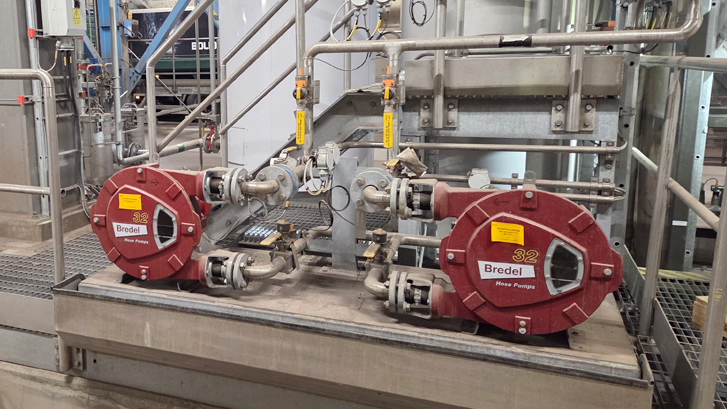
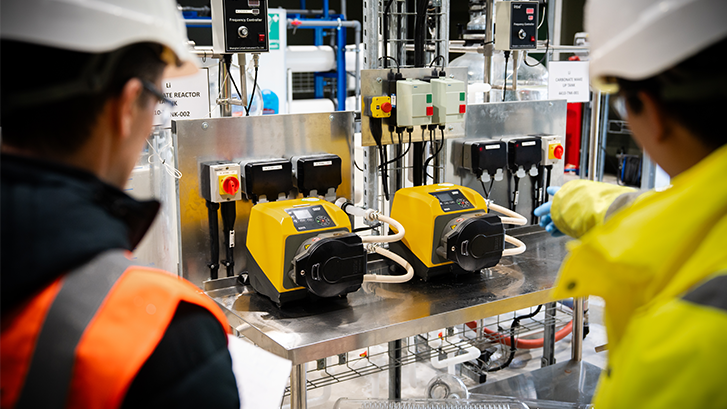
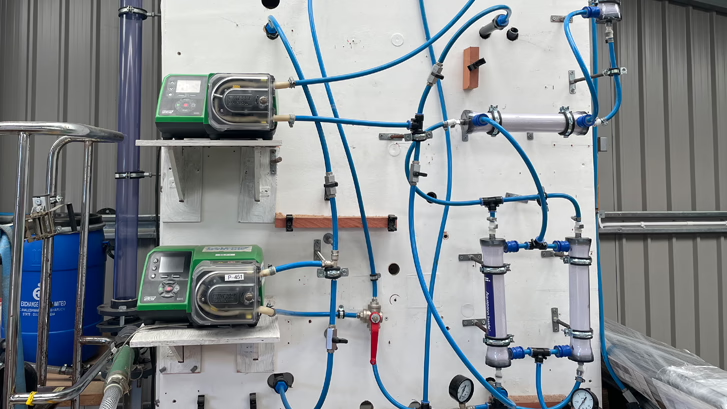
At its Cross Lanes Geothermal Lithium Project, Cornish Lithium plans to drill two 8-inch wells to depths of 2 km to extract lithium-rich brine. The product from the treated brine is intended to be processed on a test rig featuring two Watson-Marlow 500 peristaltic cased pumps for transferring lithium sulphate or chloride solution to an osmosis-based technology for concentrating and cleaning the product.
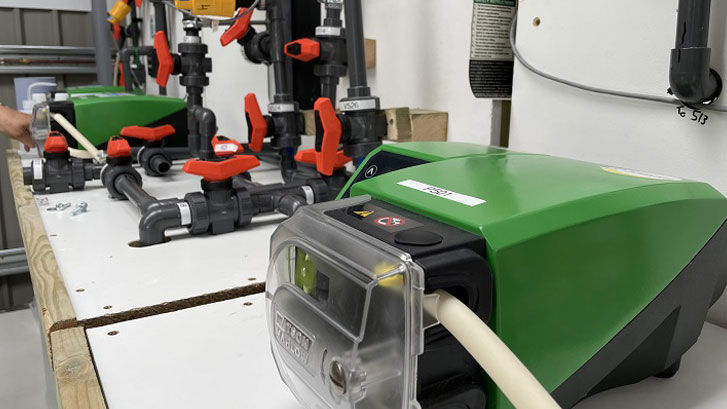
Watson-Marlow 500 series pumps are designed for precise chemical dosing in processing laboratories and provide Cornish Lithium with accurate flow control, ease of operation and fluid containment.
Mark Harris, Lead Process Engineer at Cornish Lithium’s Cross Lanes Geothermal Lithium Project, said: “We use the Watson-Marlow pumps on the test rig for their control, low flow of 12 L per minute in the refining and concentration of lithium sulphate. Other pump technologies can struggle to deliver that level of control in this application.”
Product
Smooth bore hose for chemical and other fluid flow applications where rough usage may occur.
Flexible hose assemblies
Case Study
How robust peristaltic technology supports high density slurry transfer, polymer handling and...
Case Study
Case Study
GEL uses Watson-Marlow 630 and Qdos pumps for precise dosing, safer chemical handling and...
Case Study
Case Study
Cornish Lithium is focussing on the sustainable extraction of lithium and other battery metals in...
Case Study
To order a product or ask a question call +66 2 055 0888 or