

- Insight
How to select the right pump for cardiac ablation devices
What to consider when choosing a pump for cardiac ablation devices
By Rodd Turnquist, National Sales Manager - OEM
What to consider when choosing a pump for cardiac ablation devices
By Rodd Turnquist, National Sales Manager - OEM
With the global population aging and rates of obesity rising, cardiovascular diseases are the leading cause of death globally. The most common form of cardiac arrhythmia atrial fibrillation (AF) which causes an irregular and often abnormally fast heart rhythm. Healthcare providers use cardiac ablation, a minimally invasive procedure that creates scars to stop the electrical impulses that cause irregular heart rhythms, to manage abnormal heart rhythms which have not responded to medication.
Cardiac ablation uses precise heat or cold to create a lesion or scarring in the heart wall that blocks the errant electrical signals that cause the arrhythmia and, as such, can potentially offer a cure rather than relying on lifelong treatment. With the increase in prevalence of AF and other arrhythmias, the demand for these surgeries is growing, and as such, the atrial fibrillation devices market is the fastest-growing sector in the medical device industry, expected to reach $17.9 billion by 2032. Of this, over 59% of the market is captured by ablation catheters. There is therefore a clear need for medical device manufacturers to produce reliable, effective and efficient devices that can deliver the precision these surgeries demand.
Heart surgery involves complex procedures that can have significant risks and extensive recovery times; however, the move to minimally invasive surgeries is helping to reduce this risk and improve recovery. The target area is reached using catheters to minimise the incision, but this compact size increases the demands on the devices used.
The temperature of the catheter’s surgical tip must be closely controlled in order to ensure it delivers the required energy for the surgery without causing damage to other surrounding healthy tissues. This requires a steady flow of fluid to maintain the temperature, which in turn demands a consistent pressure and flow rate from the pump supplying the fluid. These small devices utilise narrow tubes and therefore require high-performance peristaltic pumps to provide consistent flow rates and overcome back pressure.
For OEM and medical device developers, processes continue to evolve, and devices must deliver increased accuracy, improved flow control, and longer uptime of the entire system to compete in this market. This relies on every component being optimised for this application, with particular demand on the pump that is integrated into the device.
If using components from third parties, these must be easy to integrate with the device; otherwise, it could increase time to market and cause issues with configuration and installation. A transition from analogue to digital pumps is helping to deliver enhanced control, but this also relies on ease of integration with the wider control system. Compatibility with industrial Ethernet as well as analogue systems will facilitate remote monitoring and control.
Partnering with an experienced OEM pump supplier offers a unique understanding of the demands of the industry with bespoke pumps ideally suited to support a customer’s applications. This minimizes development time, effort, and risk, as the pumps are easy to test, configure, and install.
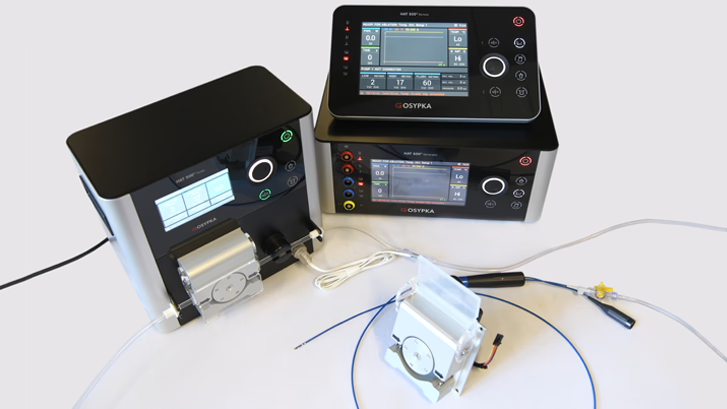
Surgical devices must be cool, quiet, and compact, with ease of cleaning and sterility of utmost importance. This is all in an industry with increasingly stretched budgets, so the cost of devices must be competitive. As this pressure is passed onto the component manufacturers, they must balance efficacy with cost to deliver for their customers.
Radiofrequency catheter ablation can be used to efficiently treat cardiac arrhythmias. During treatment, radiofrequency energy (500 kHz) is transmitted via a catheter inserted through a vein under x-ray control.
An irrigation pump is required for flushing and cooling the catheter during these cooled ablation procedures, and the 400RXMD OEM pump from Watson-Marlow is ideally suited to provide the flushing and cooling of the catheter used in these surgical ablation systems. It offers low noise levels and precise control alongside simple integration, which reduces the time and cost associated with extended installation. The 400RXMD is available with DriveSure, which integrates motor, mounting, and supports industrial Ethernet as well as analogue protocols.
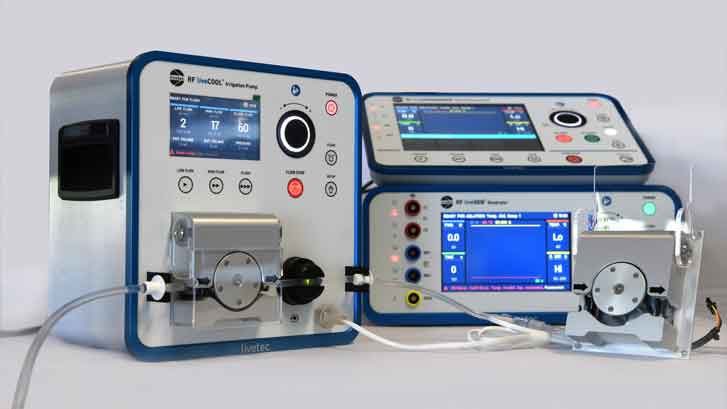
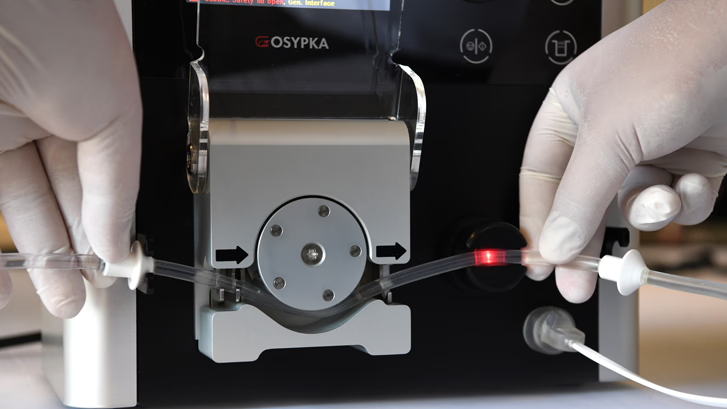
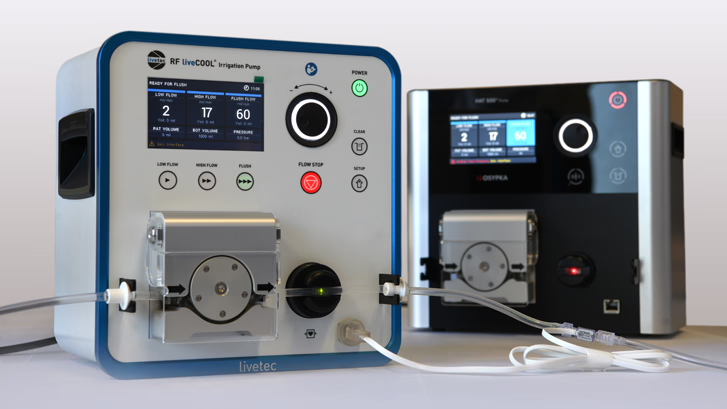
Medical device manufacturers livetec Ingenieurbüro and OSYPKA have integrated a 400RXMD peristaltic pump into their cardiac ablation system for its high reliability and ease of operation.
“None of the other pumps we tested could deliver similar delivery rates, and they were not as good in terms of mechanical compatibility as the Watson-Marlow 400RXMD," said Michael Schirmeier, managing director at livetec.
The peristaltic pump is one of the central components in the system and must provide absolute reliability over several years and many treatments. For each operation, the pump must provide saline solution continuously over several hours—any malfunction would lead to a discontinuation of treatment—so absolute reliability of all components is essential. The 400RXMD incorporates a quadruple bearing design and a track that only moves vertically to deliver superior pressure stability. Combined with precious machined parts and having been proven through thousands of procedures as part of validated medical devices, this delivers confidence in its robust construction.
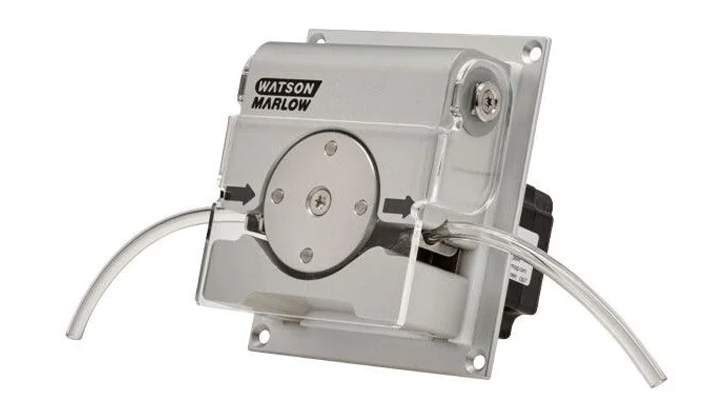
Overcoming the high back pressure created by the narrow catheter channels with a very small diameter is a key requirement of the pump selected. It must also be possible to precisely control the flow rate so that the exact volume flow required for the respective treatment step is achieved.
The 400RXMD offers flow rates of up to 500 mL/min and a pressure of up to 8 bar, so it can handle the high back pressure present in ablation applications.
The peristaltic pump for irrigation has a clear user interface with a high-resolution colour touch display for easy operation without lengthy training times. As it is crucial that no air enters the bloodstream during treatment, sensors are fitted to the device offering permanent detection of air bubbles > 2 µL and, upon detection, will automatically stop, as well as vital permanent monitoring and display of pressure and flow rate.
Cardiac ablation continues to develop with more effective and efficient treatment solutions becoming available. One of the latest developments in this field is pulsed field ablation (PFA) which uses short bursts of high energy to affect heart tissue that causes AFib instead of heat or cold.
There is also a large and growing emerging market for medical robotics, especially within surgical devices. Robotic technologies offer the potential advantages of improved consistency, reduced human error, and enhanced efficiencies and are therefore likely to revolutionise surgical devices in the forthcoming years.
For device manufacturers, irrigation of the catheter tips will still be required so effective pumps will remain a core component of future devices.
Much like the heart, the pump is at the core of a medical device and its functionality is key to the device’s wider performance. Ensuring that the chosen pump not only meets the requirements for pressure and flow rate, but also delivers exceptional reliability, all within a quiet and compact casing, are vital considerations for OEM developers. Partnering with a supplier that is experienced in components for medical devices helps to ensure that the chosen pump delivers across the board.
A full version of this article can be viewed here
Learn more about our solutions for medical devices
WMFTS products are used by customers in the manufacture of medical devices. WMFTS products are not classified as medical devices in their own right.
Updated
Precision pump used within surgical cooling applications which require flow control to specified, high pressures.
Pumps - panel mount pumps
Accurate low flow pumps help automate diabetes control device
Case Study
livetec and OSYPKA integrate 400RXMD peristaltic pump for reliability and easy operation
Case Study
Learn more about our complete panel-mount solutions